2025-26 Red Card Tracker
To track red cards issued in the 2026-27 season, see our NEW 2026-27 Red Card Tracker.
See also: FIFA Fair-Play: 2026 World Cup Yellow Card and Red Card Tracker and for Major League Soccer supporters, our 2026 MLS Red Card Tracker
Football — also known as soccer — is called The beautiful game for good reason: it unites people and provides entertainment through high-pace dribbling, fancy footwork, impeccable athleticism and, at times, spectacular passes and goals. However, the game also includes an ugly side — from reckless or violent tackles, to tactical fouls that deny obvious goalscoring opportunities, to blatant unsportsmanlike conduct. Such conduct may include classless dissent or verbal abuse toward match officials, fights and, most unfortunately, discriminatory language.
Such incidents result in either a warning from match officials, a yellow card or — most severely — a red card. The latter may entail a video review by the main referee — courtesy of video assistant referee — prior to the fateful decision. For newcomers to the game, a yellow card serves as a warning and a red card is an immediate expulsion from the match, resulting in a one-match suspension at the very least; the length of these suspensions vary based on the severity of the incident that led to the red card. A player who accumulates two yellow cards in a single match is also expelled and generally serves a one-match suspension. In such cases, the suspension is usually limited to one match because the second yellow is typically the result of a less severe offence than one stemming from a direct red card.
Players receive direct red cards for violent tackles — including those involving studs above the ankle level or two feet while lunging into the player, and deliberate elbow swings or head-butts to any part of the body. Other offences worthy of a red card include verbal abuse to match officials, discriminatory language toward any individual or denying an opponent an obvious goalscoring opportunity.
Although red cards occur sporadically, when accounting for 18 to 20 clubs in a league, they accumulate rather quickly (more often than anyone would like). Moreover, the accumulation of red cards — as well as yellow cards — affects a club’s fair-play score, which in turn influences its reputation and chances of earning fair-play awards, both on an individual level for players and on a collective level for the club.
Like our other active trackers — the 2025-26 Derby Tracker, the 2025-26 Sacked Managers Tracker and the January 2026 Transfers Tracker — the 2025-26 Red Card Tracker covers clubs from Europe’s top five leagues:
Bundesliga (Germany);
LaLiga (Spain);
Ligue 1 (France);*
Premier League (EPL);** and
Serie A (Italy).
Red Cards Accumulated, by League
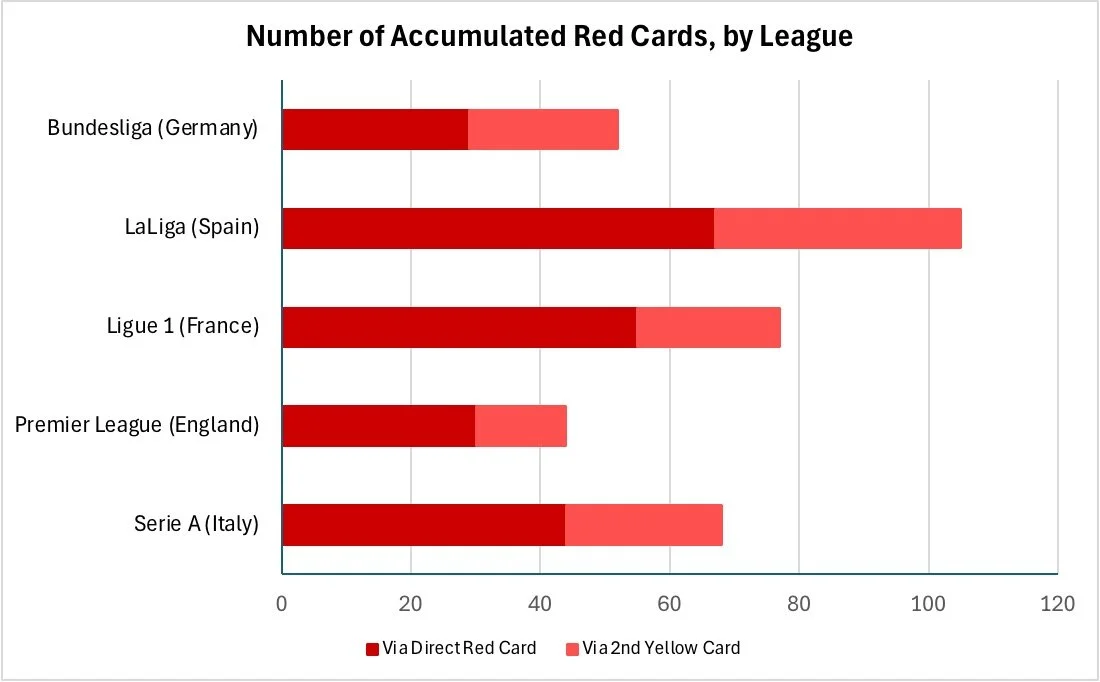
Among the top five European leagues — Bundesliga, LaLiga, Ligue 1, EPL and Serie A — LaLiga clubs have collectively accumulated an astounding 105 red cards, the highest number among the five leagues. Conversely, EPL clubs have accumulated 44 red cards, the lowest among the five leagues. However, that low figure may stem from the EPL generally being a more physical, and thus, lenient league when it comes to sanctioning players who committed fouls.
Figure 1 shows the number of red cards accumulated by clubs in each of the five European leagues mentioned above.
Note: This figure was last updated on May 25, 2026.
Source: Transfermarkt
Red Cards Accumulated in League Action, by Club
So far, some clubs have proven notably undisciplined, mustering far more red cards than anyone would like — or expect. For example, as of May 25, 2026, EPL club Chelsea FC have accumulated a whopping 11 red cards in all competitions, the highest total among all clubs from Europe’s top five leagues. Eight of those red cards occurred in league matches.
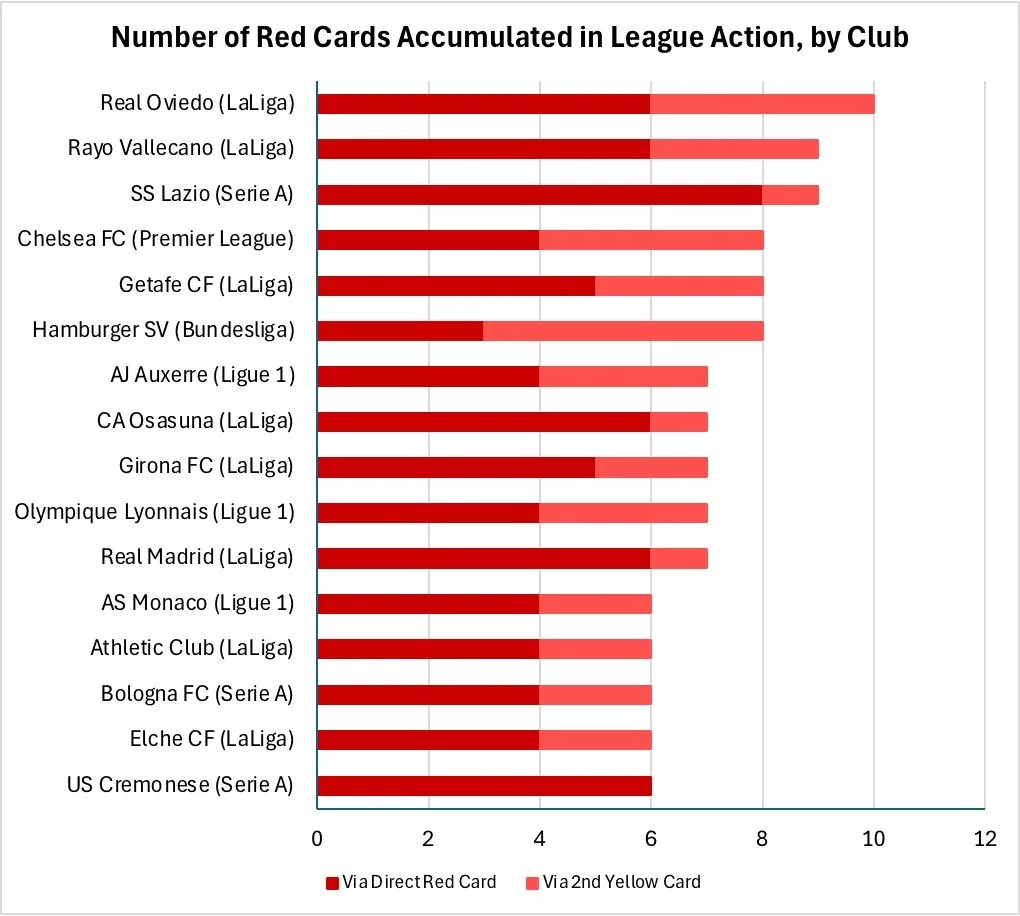
Regarding league action, LaLiga club Real Oviedo have accumulated a staggering 10 red cards, including six direct-red cards. League rivals Rayo Vallecano rank second in this category, with nine red cards, including six direct red cards. Serie A club SS Lazio have the highest number of direct red cards, with 8; the Rome-based club received nine red cards so far this season, tied with Vallecano and one ahead of Bundesliga club Hamburger SV and LaLiga’s Getafe CF.
Elsewhere, in addition to Chelsea such clubs as LaLiga’s CA Osasuna, Girona FC and Real Madrid, and Ligue 1 clubs AJ Auxerre and Olympique Lyonnais (Lyon) have each accumulated seven red cards.
Other clubs include LaLiga clubs Athletic Club and Elche CF, Ligue 1’s AS Monaco, and Serie A clubs Bologna FC and US Cremonese. These clubs have had the displeasure of accumulating six red cards, each.
Figure 2 presents the 15 clubs from Europe’s top five leagues that have accumulated the highest number of red cards in league action.
Note: This figure was last updated on May 25, 2026.
Source: Transfermarkt
Players Who Accumulated More Than One Red Card in League Action in 2025-26
Receiving more than one red card in a single season is relatively rare.. However, some players exceed that mark and acumulate multiple red cards and suspensions in a season — particularly when competing in several competitions.
The players who play for a club in one of Europe’s top five leagues and have received more than one red card in all competitions are:
Jens Castro (Midfielder/defender, Borussia Mönchengladbach), X2
Dominik Kohr (Defender, FSV Mainz), X2
Johan Manzambi (Midfielder, SC Freiburg), X2
Paul Nebel (Forward/midfielder, Mainz), X2
Niklas Stark (Midfielder/defender, Werder Bremen), X2
Fábio Vieira (Midfielder, Hamburger SV), X2
Wesley Fofana (Defender, Chelsea FC), X2
Christian Romero (Defender, Tottenham Hotspur), X2
Federico Viñas (Forward, Real Oviedo), X3
Pathé Ciss (Midfielder, Rayo Vallecano), X2
Djene Dakonam (Defender, Getafe CF), X2
Íñigo Lekue (Defender, Athletic Club), X2
Nobel Mendy (Defender, Rayo Vallecano), X2
Charles Pickel (Midfielder, RCD Espanyol), X2
Thibault De Smet (Defender, Paris FC), X2
Ismaël Doukouré, (Midfielder/defender, RC Strasbourg), X2
Thilo Kehrer (Defender, AS Monaco), X2
Donovan Leon (Goalkeeper, AJ Auxerre), X2
Sadibou Sané (Defender, FC Metz), X2
Arouna Sangante (Defender, Le Havre AC), X2
Nicolás Tagliafico (Defender, Lyon), X2
Mariano Troilo (Defender, Parma Calcio), X2
With just over one month remaining in the 2025-26 season, it will be interesting to see which players and clubs remain disciplined during the business end of the season.
*Ligue 1 also includes AS Monaco, which are based in the Principality of Monaco.
**The EPL may include a number of clubs from Wales. These clubs, which currently participate in one of the English Football League’s top four divisions, include EFL Championship clubs Swansea City and Wrexham AFC, EFL League One club Cardiff City and EFL League Two club Newport County. That said, there are no Welsh clubs competing in the EPL for the 2025-26 season.