European Clubs That Have Won 20+ League Titles (2026 Update)
By: AT
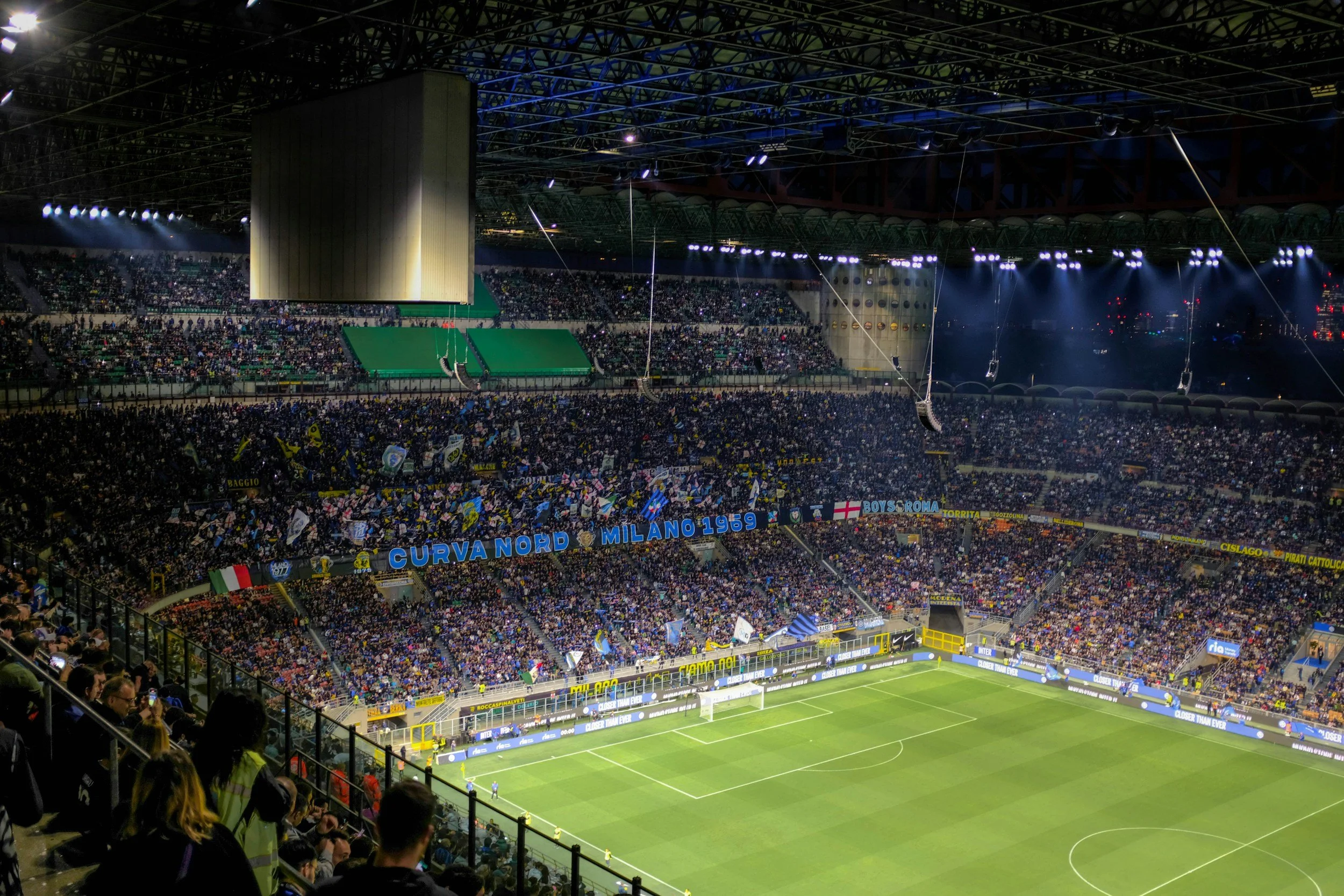
Image Credit: Zach Rowlandson
On April 27, 2025, Premier League (EPL) giants Liverpool FC defeated league rivals Tottenham Hotspur at Anfield to secure their 20th English top-flight league title. This victory places The Reds among an elite cohort of major European clubs that have won 20 league titles, thereby earning the right to display the famous second star above their crest. Liverpool joined an elite cohort of major European clubs from the top five leagues (Serie A, Bundesliga, Premier League and LaLiga) that have won 20 league titles. (No French club has earned 20 Ligue 1 titles.)
In 2025-26 — so far — Bayern Munich captured their 35th Bundesliga title, Inter Milan clinched their 21st Serie A title and FC Barcelona earned their 29th LaLiga title.
England (Liverpool FC & Manchester United)
Liverpool FC (20 titles)
Despite winning their 20th league title in 2025, Liverpool have won only two league titles since the inception of the EPL in 1992-93.*
Liverpool’s first 18 titles came during the pre-EPL-era throughout a 90-year period, beginning in 1900-01, when the league was called “The Football League” and consisted of only 18 clubs. Five years later, after The Football League expanded to 20 clubs in 1905, Liverpool won their second league title. Liverpool earned subsequent titles consecutively in 1921-22 and 1922-23, and another in the post-Second World War (WWII)-era in 1946-47.
Liverpool later established two distinct dynasties: one in the 1960s under manager Bill Shankly, and another in the 1970s and early 1980s under legendary manager Bob Paisley, who had also won the 1946-47 league title as a Liverpool player. Under Shankly, The Reds won league titles in 1963-64 and 1965-66, while also earning their first FA Cup titles during the in-between season.
Paisley subsequently guided Liverpool to leagye titles in 1975-76, 1976-77 and 1978-79 after serving as assistant manager during the club’s 1972-73 triumph. Those titles brought Merseyside club to 10 league titles and earned The Reds their first gold star.
The 1980s became The Reds’ most successful decade in English football. The club added further titles in 1979-80 — a consecutive said title at that point — 1981-82 and 1982-83 under Paisley. In 1983-84, newly appointed manager Joe Fagan led Liverpool to a third-consecutive league title, a first in club history. In the second half of the 1980s, led by player-manager Kenny Dalglish — another legend of the beautiful game — Liverpool garnered league titles in 1985-86, 1987-88 and 1989-90, capping an 11-season period in which they won seven league titles.
Liverpool finally returned to league-glory in 2019-20 by winning their first EPL-era title. That season, The Redsmustered a then-league-record and outstanding club-record 99 points, including 32 wins in 38 matches. Combined with their latest EPL title in 2025, The Reds reached the 20-title milestone and joined Europe’s elite cohort of clubs that have won at least 20 league titles.
Manchester United (20 titles)
In addition to Liverpool, between the former First Division and the current Premier League Manchester United* are the only other English club — during their 146-year history — to win 20 league titles. Their first league title came in 1907-08, which marked the 20th anniversary of the First Division. The Red Devils won their second league title only three years later during the 1910-11 season. However, The Red Devils would not win another league title until 1951-52. Manchester United added consecutive league titles in 1955-56 and 1956-57 under Matt Busby.
In the following season, however, the club suffered the Munich air disaster, in which eight Manchester United players lost their lives and two suffered career-ending injuries. While chasing a third consecutive title, Manchester United dropped 21 points during the final 14 matches and finished (ironically) 21 points behind Wolverhampton Wanderers, which won their second league title.
Over the next 35 years, the club experienced a rocky period during which winning trophies occurred sporadically. However, they enjoyed a five-year window between 1963 and 1968, in which they won the league title in 1964-65 and in 1966-67.
On November 6, 1986, Manchester United unknowingly made the best decision in their club’s history: hiring Sir Alex Ferguson (SAF) as manager. After coaching Scotland — his home country — during the 1986 FIFA World Cup, SAF presided over a club in turmoil and promised United a return to the glory days preceding the Munich disaster.
His promise began to pay off in the 1990s after winning the inaugural and second Premier League titles in the 1992-93 and 1993-94 seasons, respectively. In the second half of the 20th century’s final decade, United won three titles in 1995-96, 1996-97 and 1998-99. During the 1998-99 season, United achieved ultimate glory, winning their first (and only) treble — winning the Premier League, the FA Cup and UCL — in club history.
At the turn of the century — still under SAF’s reign — United continued their elite form and captured two consecutive league titles, which culminated in the club’s first three-peat. Amid the rise of the “Invincibles” at Arsenal and José Mourinho’s impeccable championship-level management at Chelsea, SAF managed to win only one league title — in 2002-03 — over the following five seasons. However, Arsenal’s relative decline and Mourinho’s sacking in fall 2006 enabled SAF to steer United towards another three-peat from 2006-07 to 2008-09.
Over the next four years — the last of SAF as manager of the club — United won their 19th and 20th league titles in 2010-11 and 2012-13, respectively. However, in 2009-10 and 2011-12, The Red Devils infamously lost the league title on both occasions during the last matchday at the hands of Chelsea and Manchester City.
After returning to championship status in 2013, SAF announced his retirement on a high note and the club later hired David Moyes from Everton FC as SAF’s replacement. Since then, United have gone on a roller coaster and have not won another league title. Moreover, they continue looking for a lasting identity, which has resulted in management turnover approximately every second year.
Germany: Bayern Munich (35 titles)
Across the Alps and into Bavaria lies Bayern Munich, which won 34 league titles in their 125-year history. Similar to Juventus, Bayern won their first league title in 1932 under a differently branded and formatted league — the German football championship — following a 2-0 victory in the competition’s final against Eintracht Frankfurt.
Entering the “Golden Years,” Bayern won their first league title (second overall) under the current German professional football format — with the Bundesliga at the top of the German football pyramid — during the 1968-69 season. Then, Bayern won three consecutive league championships from 1971-72 to 1973-74. The “Golden Years” coincided with the rise of an elite West German national team that captured the 1972 UEFA European Championship and the 1974 FIFA World Cup. That team, including a number of their star players, consisted of many Bayern players.
In the 1980s, Bayern continued exhibiting their dominance with six additional titles, including a three-peat from 1984-85 to 1986-87. Aside from their three-peat Bayern earned their three additional titles during the following seasons: 1979-80, 1980-81 and 1988-89.
Over the next 20 years — from 1990 to 2010 — Bayern Munich won an additional 11 league titles, including two instances that comprised consecutive championships — in 1998-99 and 1999-2000, as well as 2004-05 and 2005-06.
Following a two-year drought marred by back-to-back league titles — in 2011 and 2012 — for rivals Borussia Dortmund, Bayern becameDie Meister again… for the next eleven seasons between 2012-13 and 2022-23, a German record. During that time, Bayern won two trebles — the league title, the domestic cup and the UEFA Champions League — during the 2012-13 and 2019-20 seasons. Although Bayer Leverkusen’s first Bundesliga title win in 2023-24 ended Bayern’s streak of league titles, the Bavarian club returned to championship status after capturing the 2024-25 Bundesliga title in convincing fashion. The Bavarian club promptly repeated as Bundesliga winners the following season, claiming a 35th title. The 2025-26 season was highlighted by a stellar attacking trio of Luis Díaz, Harry Kane and Michael Olise, which combined over 100 goals in all competitions.
Note: One may notice that Bayern Munich’s crest sits below five stars, rather than a conventional three stars following 30 titles. Bayern’s kits display five stars because the Deutsche Fussball League’s matchwear guidelines indicate that 30 titles earns five stars. With this system in place, Bayern earned their second star after five titles; the first star is awarded to a club following their third title. Finally, 10 titles earn three stars, whereas 20 titles earn a fourth star.
Italy: Inter Milan & Juventus FC
Inter Milan (21 titles)
Inter Milan earned their 20th league title in 2023-24 after defeating archrivals AC Milan 2-1 at the iconic San Siro. Inter hoisted their 19 other league titles within a 111-year period between 1909-10 and 2020-21. Their first, in 1909-10, occurred at a time when the league was named “Prima Categoria”. Inter won their second said title in 1919-20, which marked the first season of action in Italian football after World War One.
Then, after a decade in which the Italian first division had undergone two different rebrands, Inter earned their third Scudetto (colloquially known in Italy as the league title) in 1929-30, the first season in which the league was named “Serie A”. Later that decade, with the world on the brink of WWII, I Nerazzurri won two Serie A titles in three seasons, winning the league title in 1937-38 and 1939-40, and hoisting their first Coppa Italia title during the in-between season.
Fast forward after WWII, Inter reestablished dominance in the mid-1950s, winning consecutive Serie A titles for the first time in 1952-53 and 1953-54. However, the Milan-based club attained new heights in the 1960s, winning three Scudetti within four seasons: 1962-63, 1964-65 and 1965-66. That period was also defined by Inter winning consecutive European Cup (now UEFA Champions League, or UCL) titles in 1963-64 and 1964-65 and earning their 10th league title in 1966. As a result, Inter kicked off the 1966-67 season with a golden star donned above their club crest.
In the next 40 years, Inter experienced success sporadically, winning the Scudetto three times: 1970-71, 1979-80 and 1988-89.
In 2005-06, after winning the 2004-05 Coppa Italia title, Inter began another era of dominance. During this era, Inter earned a club-record five consecutive Scudetti between 2005-06–2009-10. That period began with I Nerazzurri also winning the Coppa Italia in 2005-06 and ended with them winning another Coppa Italia and the UCL in 2009-10, securing a first treble in club history.
After that triumph, however, Inter slid into stagnation and mediocrity. After losing their prestige in both Europe and Italy, I Nerazzuri were bought in 2013 by Indonesian businessman Erik Tohrir. Despite the change of ownership, Inter failed to improve. After a half-decade of stagnation, in 2016, Chinese firm Suning Commerce Group Ltd purchased a majority stake (68.6%) of the club.
In the final years of Juventus FC’s dominance throughout the 2010s, Inter began enhancing both club infrastructure and their squad incrementally. Inter’s actions paid off in 2020-21, when they cruised to their 19th Serie A title and ultimately overthrew the mighty Juventus by ending their nine-year reign as Serie A winners. Despite just celebrating their first league title since their treble-winning season in 2009-10, Suning defaulted on their €395 million debt, which prompted the Chinese firm to sell their majority position to American private-equity firm Oaktree Capital. Three years later, Inter won that elusive 20th title, a first in the Oaktree Capital-era. I Nerazzurri would repeat this triumph in 2025-26, winning their 21st Scudetto, which also marks a second in the last three seasons.
Juventus FC (36 titles, originally 38)
Not too far away from Milan, Juventus FC became the first Italian club to achieve this exceptional accolade. The Piedmont-based club won their first Scudetto during the Prima Categoria-era in 1905. Their second league title was achieved under the format of the 1925-26 Prima Divisione, which comprised two conferences in the top division, with the top team from each conference facing off in the final. In the 1926 final, Juventus defeated Bologna following a 2-1 tiebreaker victory.
Their next eight league titles — won under the Serie A format hereafter — occurred during a period between the 1930-31 and 1957-58 seasons. Then, Juventus reached 20 league titles following the 1981-82 season, which included five titles within a span of seven seasons from 1971-72 to 1977-78.
As of the 1980s, Juventus claimed a myriad of titles that included two additional titles in three seasons — in 1983-84 and 1985-86 — and three titles in four seasons from 1994-95 to 1997-98.
Following a tumultuous first decade of the 21st century — which included four consecutive league titles from 2001-02 to 2004-05 and a relegation to Serie B in 2005 following the Calciopoli scandal — Juventus rose into a dynasty during the 2010s. In 2011-12, Juventus went on a 43-match unbeaten run and won their first league title in nine years. Juventus would go on to win another eight consecutive Scudetti, with their 30th league title earned following the 2013-14 season. Their 36th and final league title to date would be hoisted following the 2019-20 season during the Cristiano Ronaldo and not-so-pleasant COVID-19-era.
Note: In addition to relegation to Serie B in the wake of the Calciopoli scandal, Juventus were also stripped of their 2003-04 and 2004-05 league titles, with the latter awarded controversially to Inter Milan.
Spain: Real Madrid and FC Barcelona
FC Barcelona (29 titles)
Travelling back to southern Europe, we discover two clubs within Spain that have won as many as 28+ league titles. First, there lies FC Barcelona within the Catalunya region. The club’s first title came during LaLiga’s inaugural season in 1929, which was then named Primera División. That season consisted of 10 clubs, each of which played 18 matches. Barcelona emerged on top with 25 points (a win earned two points).
Barcelona would return to a championship pedigree immediately after World War II — a period also marred by domestic political turmoil and civil war — by winning titles in 1944-45, 1947-48 and 1948-49. The Primera División comprised 14 clubs in each of those seasons, with each club playing a total of 26 matches.
In the 1950s, Barcelona won three additional league titles, which were followed by one more championship in 1959-60. In an era of 16 clubs contending for the league title, Barcelona’s consecutive titles in 1959 and 1960 earned the club its first and second berths to the new European Cup (now UCL). Barcelona entered the 1960s on an incredibly high note with seven league titles and standing high as two-time defending league champions.
Then, however, the Catalan club endured a 14-year drought without a league title. The 1960s proved an incredibly difficult year for the club, winning only two Copa del Rey titles — the Spanish cup — in 1962-63 and 1967-68. Barcelona’s eighth league title finally materialized in 1973-74, a season dominated by the flair of legendary Dutch forward Johan Cruyff. At this point, the league was rebranded to “LaLiga” and consisted of 18 clubs.
Despite the iconic stature of the Catalan club, Barcelona became a bona fide elite club only within the past few decades. The club earned their 10th title and a first star on their crest in 1990-91, with a squad that included the likes of superstars Ronald Koeman and Romario. This achievement kickstarted a period of domestic dominance that included four consecutive league titles.
In the late 1990s, Barcelona rose once more to domestic prominence after winning two consecutive league titles in 1997-98 and 1998-99. Then, in part owing to the rise of the Galáticos-era at Real Madrid, Barcelona had to wait until 2005 and 2006 for their 17th and 18th league titles.
However, in 2008-09, the Catalan club closed the 2000s on an incredibly high note under Pep Guardiola by winning their first treble — LaLiga, Copa del Rey and UCL — in club history, which was then followed by an eighth Supercopa de España, a third UEFA Super Cup and their first FIFA Club World Cup title in club history.
From a domestic perspective, Barcelona dominated the 2010s, winning three LaLiga titles in the first four years — 2009-10, 2010-11 and 2012-13 — the first of which being the club’s 20th league title, thereby earning a second star on their crest.
Then, Barcelona won a second treble in 2014-15 under then-manager Luis Enrique, with the remaining years of the 2010s comprising three additional league titles: in 2015-16, 2017-18 and 2018-19. Since the turn of the current decade, Barcelona have won league titles in 2022-23, 2024-25 and 2025-26.
Real Madrid (36 titles)
Considered by many as the most successful club in the sport’s history, Real Madrid became a powerhouse during the 1930, which included two consecutive league titles in 1931-32 and 1932-33, which were the club’s sixth and seventh such titles. During World War II and the Spanish Civil War, a certain Santiago Bernabéu became president of the club and began rebuilding the club once both conflicts came to an end. After acquiring legendary Argentine Alfredo Di Stéfano, Madrid had risen to prominence, winning four LaLiga titles in a five-year span between 1953-54 and 1957-58.
Madrid continued their dominance in the 1960s, winning five league titles between 1960-61 and 1964-65, including their 10th title – and thus earning their first star above their crest – in 1964, and the Copa del Rey in 1961-62. Despite finishing runners-up only one point behind local rivals Atlético Madrid – which won their fourth league title – Madrid returned to champion status from 1966-67 to 1968-69.
Although the first half of the 1970s comprised only one LaLiga title in 1971-72 and a Copa del Rey title in 1973-74, Madrid dominated the Spanish first division in the second half of that decade; the club won five LaLiga titles during a span of six seasons from 1974-75 to 1979-80, which included their second and third league doubles in 1974-75 and 1979-80. The club exited the 1970s as one of the best clubs in the world and entered the 1980s with their 20th league titles, which earned them a second star to engrave above their crest.
Madrid regained their league prestige in the late 1980s, winning LaLiga for an additional four consecutive seasons from 1986-87 to 1989-90, which brought the club to a quarter-century worth of titles.
Interestingly, the 1990s mirrored the 1970s and 1980s, with Madrid winning only one Copa del Rey title and a Supercopa de España during the first half of the decade; both titles were won in 1993. In the second half of the decade, however, Real Madrid returned to their usual selves, capturing two league titles in 1994-95 and 1996-97.
At the turn of the century, the club seemingly lost their domestic dominance at the hands of Catalan rivals FC Barcelona. Madrid would win only two league titles in the first half of the 2000s, particularly in 2000-01 and 2002-03.
While Madrid’s European prestige faded during the second half of the 2000s, they returned to winning ways in LaLiga, claiming back-to-back titles in 2006-07 and 2007-08. The first of these two titles earned the club a third star above their crest, becoming the first Spanish club to achieve this elite accolade.
In the 2010s, Madrid once again struggled to overcome their early decade curse, winning only one title under “The Special One” José Mourinho in 2011-12. However, it would not be until 2016-17 that the club would return as LaLiga champions, winning their 33rd league title.
As the turn of the decade was marred by the COVID-19 pandemic, and the ensuing lockdowns and hiatuses of football leagues across the world, Real Madrid returned to action by surpassing rivals Barcelona and capturing their 34th league title and hoisting the trophy unceremoniously behind closed doors. After pandemic restrictions were lifted, Madrid — under Ancelotti’s second stint as Madrid manager — won their 35th and 36th LaLiga titles in 2021-22 2023-24, respectively.
Other European Clubs
Outside of Europe’s top five leagues — notably Europe’s sixth to 10th-best leagues — nine clubs have achieved the elite accolade of winning 20 league titles (no club from Czechia’s First League has won 20 league titles). The clubs to have achieved this include:
The Netherlands: Eredivisie
Ajax: 36 (last won: 2021-22)
PSV Eindhoven: 27 (2025-26)
Belgium: Belgian Pro League
Anderlecht: 34 (2016-17)
Portugal: Primeira Liga
SL Benfica: 38 league titles — a record among clubs from European major European leagues (2022-23)
FC Porto: 31 league titles (2025-26)
Sporting CP: 21 league titles (2024-25)
Türkiye: Süper Lig
Galatasaray — 26 league titles (2025-26)
—————
*Unless indicated otherwise, all information for Liverpool and Manchester United is cited from those linked sources.